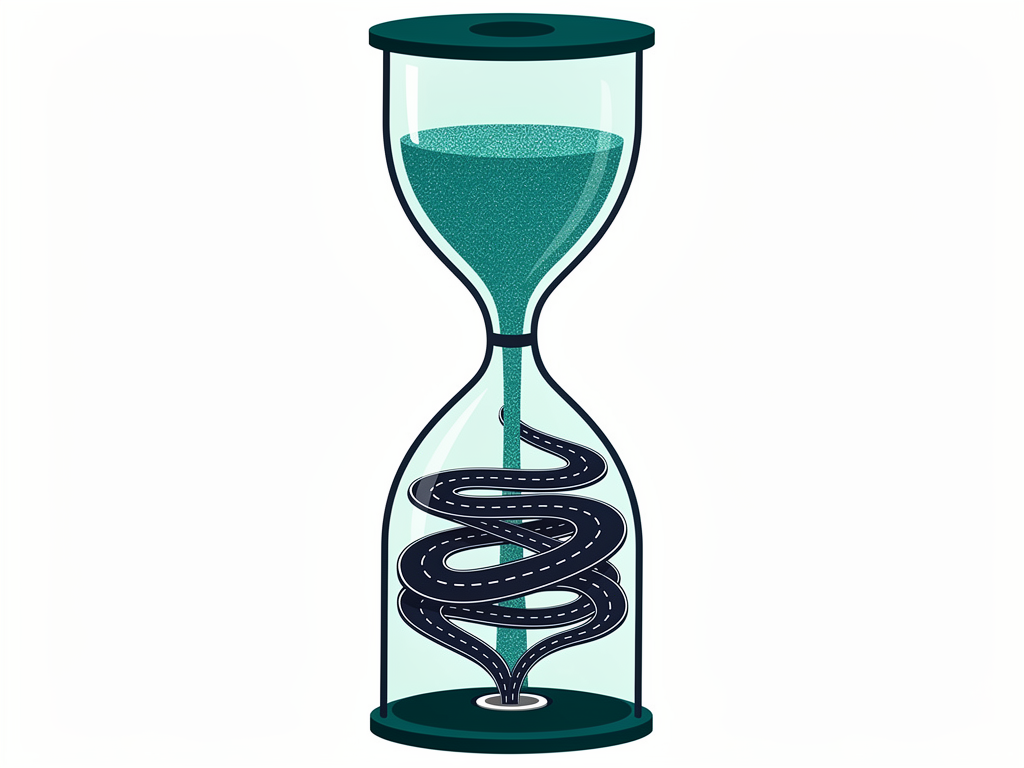
The Tax That Doesn't Show Up on the Report
Guesswork in hiring, expansion, or territory design doesn't fail loudly. It fails slowly — through delays, misallocation, and compounding risk.
In veterinary field sales, that slow failure has a specific name: windshield time. Every hour a rep spends driving between accounts is an hour not spent in front of a decision-maker, not closing a reorder, not building the relationship that determines which vendor gets the formulary position. The cost is real. It rarely appears in any territory performance analysis.
Most territory reviews look at revenue per rep, call volume, and win rates. Almost none look at drive time as a structural variable. That omission means the root cause of underperformance in field sales — how territories are actually shaped — stays invisible while sales leadership cycles through tactical fixes: more calls, better scripts, pipeline coaching. None of it addresses the underlying geometry of the problem.
What Windshield Time Actually Costs
Start with rep capacity. A field rep working a five-day week has roughly 40 to 45 productive hours available. If average drive time between accounts runs 45 minutes each way — not unusual in territories that were drawn on a map rather than built around practice density — a rep completing six calls per day burns four to five hours in transit. That's 20 to 25 hours per week in the vehicle. More than half the working week, gone.
The downstream effects compound quickly:
- Call frequency drops. High-priority accounts that require monthly visits get quarterly ones. Relationships erode. Competitive vendors fill the gap.
- Coverage becomes uneven. Reps optimize naturally — they cluster calls near home or near each other. High-value accounts at the edge of the territory go underserved regardless of their revenue potential.
- Opportunity cost is invisible. The specialist referral practice doing 40 procedures a week that never gets a visit doesn't show up as a loss. It shows up as a blank line in the CRM — which looks like no opportunity, not a missed one.
A territory generating $1.2M annually with a rep spending 50% of their time in transit is not a $1.2M territory. It's a territory with an unknown ceiling — because no one has measured what it would produce if the rep could actually reach it.
The Root Cause: Geography as a Proxy for Territory Design
Most veterinary sales territories were not designed. They were inherited, split, or approximated. A regional manager drew a line through a state map, assigned zip codes, and called it a territory. That approach made sense in an era when practice data was sparse and field sales was less competitive. It doesn't hold up now.
The core problem is that geography — square mileage, county lines, regional boundaries — is not the same as market structure. A territory that covers three rural counties and one dense suburban corridor is not one territory. It's two completely different operating environments that happen to share a rep. Drive time between the rural cluster and the suburban cluster might exceed 90 minutes each way. The rep can't serve both efficiently. So they serve neither well.
This is the structural misalignment that underlies most territory underperformance in veterinary field sales. It's not a rep performance issue. It's a design issue. And it won't be fixed by adding headcount or adjusting quota — it requires rethinking the unit of territory itself. For a detailed breakdown of how this misalignment compounds over time, see veterinary sales territory structural misalignment.
What Density-Optimized Territory Design Looks Like
Density-optimized territory design starts from a different question. Not: what geography should this rep cover? But: what cluster of accounts can this rep reach efficiently, at the required frequency, to maximize revenue contact?
In practice, this means three things:
- Account clustering by drive-time radius, not boundary lines. Practices within a 20-minute drive of each other belong in the same territory, regardless of county or zip code. Practices that require 60-minute drives to reach should be evaluated against their revenue potential before they're included — not assumed to be in scope because they fall inside a line on a map.
- Priority tiering based on account value and visit frequency requirements. A high-volume specialty practice might require monthly visits. A general practice with moderate revenue potential might warrant quarterly. Drive-time optimization changes when you account for the fact that not all accounts need to be visited at the same frequency — and that high-frequency, high-value accounts should anchor the territory center, not sit at its edges.
- Drive-time mapping as a design input, not an afterthought. Actual road network travel times — not straight-line distance — determine whether a territory is workable. A territory that looks compact on a map may be operationally fragmented because of highway access, traffic patterns, or geographic barriers.
The output of this process is a territory that a rep can actually execute — where the call plan is physically achievable, high-value accounts are reachable at the required frequency, and windshield time is a known, managed variable rather than an invisible drag on productivity.
The Data Inputs Required to Do This Right
Density-optimized territory design is not a routing exercise. It requires structured practice-level data that most veterinary vendors do not have in usable form.
The minimum data inputs are:
- Practice location at the address level — not zip code centroids, which introduce significant positional error at the territory edge.
- Capability and service tier — whether a practice is general, emergency, specialty, or mixed. A practice's capability tier determines its product relevance and visit priority, not just its revenue history.
- Revenue potential, not just revenue history. Existing revenue reflects what the rep has captured. Potential reflects what the account could produce. Territories built on historical revenue alone systematically underweight emerging practices and newly opened clinics.
- Visit frequency requirements by account tier — which requires knowing which accounts are high-touch, which are low-touch, and what the coverage logic is at the product or category level.
Without this data, territory design defaults to the geometry of boundaries — which is where most veterinary sales organizations are stuck today. The consequence is that decisions made without this foundation carry compounding risk, as outlined in the hidden cost of guesswork in veterinary market intelligence.
VetPulse delivers custom data assets built for your use case — scoped by geography, depth, and operational need.
That scoping matters. Territory optimization for a national pharmaceutical distributor looks different from territory design for a regional equipment vendor. The geographic resolution, the practice attributes, and the priority logic all depend on the specific sales model. Generic practice lists don't support this work. Purpose-built data assets do.
Territory Design Is a Data Problem Before It's a Sales Problem
VetPulse shows where revenue effort should exist at all — before territories are rebalanced or headcount is added.
That sequencing is the point. Rebalancing territories without first understanding practice density, drive-time structure, and account tiering is rearranging the same broken geometry. Adding headcount into a poorly designed territory structure doubles the cost without fixing the underlying problem.
The vendors who are gaining ground in veterinary field sales are not necessarily fielding more reps. They are fielding reps whose territories were built around actual market structure — where the accounts are, what they're worth, and how long it takes to reach them. That design advantage compounds over time: higher call frequency on high-value accounts, stronger relationships, better competitive positioning at renewal.
Windshield time doesn't appear on the territory performance dashboard. But it's determining the outcome.
Review Your Territory Coverage
If your territory design predates a serious look at practice density and drive-time data, the coverage gaps are already costing you — you just haven't measured them yet. VetPulse provides the geospatial and practice-level data required to build territories that reflect how the veterinary market actually distributes, not how a map was divided.
Review territory coverage — and find out where your reps' time is actually going.